Tuesday, December 13, 2005

The Ultimate's

[121 Words]

(1) ultimate < (2) penultimate < (3) antepenultimate < (4) preantepenultimate

Tuesday, December 06, 2005

L.A. Hospitals

* Cedars-Sinai Medical Center, Los Angeles
8700 Beverly Boulevard
Los Angeles, CA 90048
# 14 Heart and heart surgery U.S. News Score: 32.5 Reputation: 4.5%
# 16 Digestive disorders U.S. News Score: 29.3 Reputation: 6.4%
# 23 Hormonal disorders U.S. News Score: 29.8 Reputation: 2.8%
# 27 Neurology and neurosurgery U.S. News Score: 31.5 Reputation: 0.4%
# 28 Gynecology U.S. News Score: 33.5 Reputation: 3.2%
# 37 Orthopedics U.S. News Score: 29.0 Reputation: 0.9%
# 44 Kidney disease U.S. News Score: 34.6 Reputation: 2.5%

* Children's Hospital Los Angeles
4650 Sunset Boulevard
Los Angeles, CA 90027
# 16 Pediatrics Reputation: 7.7%

* City of Hope National Medical Center, Duarte, Calif.
1500 East Duarte Road
Duarte, CA 91010
# 43 Cancer U.S. News Score: 32.7 Reputation: 4.0%

* Rancho Los Amigos National Rehabilitation Center, Downey, Calif.
7601 East Imperial Highway
Downey, CA 90242
# 13 Rehabilitation Reputation: 7.9%

* UCLA Medical Center, Los Angeles
10833 Le Conte Avenue
Los Angeles, CA 90095
# 1 Geriatrics U.S. News Score: 100.0 Reputation: 45.4%
# 4 Urology U.S. News Score: 52.4 Reputation: 26.2%
# 5 Digestive disorders U.S. News Score: 46.7 Reputation: 21.9%
# 5 Ophthalmology Reputation: 34.7%
# 6 Orthopedics U.S. News Score: 42.3 Reputation: 13.6%
# 7 Gynecology U.S. News Score: 49.0 Reputation: 12.4%
# 7 Rheumatology Reputation: 24.2%
# 8 Cancer U.S. News Score: 40.6 Reputation: 6.7%
# 8 Kidney disease U.S. News Score: 65.6 Reputation: 14.6%
# 9 Ear, nose, and throat U.S. News Score: 50.2 Reputation: 13.8%
# 9 Neurology and neurosurgery U.S. News Score: 46.8 Reputation: 14.9%
# 11 Hormonal disorders U.S. News Score: 38.1 Reputation: 11.0%
# 12 Pediatrics Reputation: 8.5%
# 13 Heart and heart surgery U.S. News Score: 32.8 Reputation: 6.7%
# 15 Respiratory disorders U.S. News Score: 34.6 Reputation: 8.2%

* UCLA Neuropsychiatric Hospital, Los Angeles
760 Westwood Plaza
Los Angeles, CA 90095
# 5 Psychiatry Reputation: 22.6%

* University of California, Irvine Medical Center, Orange
101 The City Drive
Orange, CA 92868
# 41 Gynecology U.S. News Score: 30.8 Reputation: 2.7%

* Doheny Eye Institute, USC University Hospital, Los Angeles
1500 San Pablo Street
Los Angeles, CA 90033
# 7 Ophthalmology Reputation: 17.6%
# 25 Gynecology U.S. News Score: 34.2 Reputation: 5.5%
# 29 Neurology and neurosurgery U.S. News Score: 31.5 Reputation: 2.3%
# 29 Orthopedics U.S. News Score: 30.1 Reputation: 2.7%
# 34 Ear, nose, and throat U.S. News Score: 33.9 Reputation: 3.3%
# 49 Hormonal disorders U.S. News Score: 26.3 Reputation: 2.4%

Next April You'll Have Liver Cancer--the Pig Brain Type

明年四月你会得肝癌症,猪脑类型的。

Last night I had a terrible dream, which woke me up. I dreamed that I went to the hospital to check my brain (for what reason I don't remember now). The doctor has such a bad memory that he always forgets things (e.g. mixing up people's names), but the nurse was a capable lady--and outspoken, too. By the time my results were ready the doctor couldn't remember or find it (of course!), so I asked a technician, who did the test and knew the result. He told me I have to take medication (not a good sign). LS and I were on the way to see my father, who is also admitted to the hospital, when we walked pass the nurse, who told me the devastating news: I will have cancer next April. "Pig brain type," she added.

I remember being shocked and standing there with LS, who is also shocked. "What?!" She said. The nurse just stood there, apperently remembering that she probably shouldn't break the news to us in such a casual way. She wanted to say something, but she didn't.

Two things went through my mind immediately: 1) they must have discovered my liver cancer by the way of examining my brain, 2) the cancer must have spread to my brain already. For a moment, my head feels like it was hit by a brick. My heart probably skipped a beat, and if there were something I was holding (e.g. a coffee cup), I would have definately dropped it on the floor.

The next thing I remember is I gain some conciousness, realizing that it was a dream, but I was not yet completely awake. Then I thought I need to create a blog to write things down for my son, who is much too young now to understand anything, so he can read it when he grows up. Thanks to Steve Jobs who gave me this idea in his speech when he was talking about death.

Then my wife woke up. It was around 2:30 a.m. We laid there and had a long talk about my dream and other things that have been troubling us lately. One thing we agreed was to get my annual physical, ASAP.

I think God is using this to shake me up a little. I've been free-falling and keep setting record lows. Although, I know God's love is deep enough that no one can fall through it. Faith is about the only thing I have these days in my struggling spiritual life. I pray that God will catch me on the fall and lift me up again. He must. I only don't know if this was it.

When I got up this morning, I felt much better. Things were so gloomy these days I remember asking God to make this the last day of my life. (Take heart, I never want to kill myself. I only asked God to take me home.) Yesterday I asked God to make this day the first day of a brand new life for me. I finally understand what the old pastor meant by 'start all over again.' In God we can. I only don't know if this was it.

Time will tell!

I need to get an appointment for the physical now. Who knows what it would reveal; and who knows what will happen next April.

Pig brain type?!

Tuesday, November 29, 2005

'You've got to find what you love,' Jobs says

This is the text of the Commencement address by Steve Jobs, CEO of Apple Computer and of Pixar Animation Studios, delivered on June 12, 2005.

I am honored to be with you today at your commencement from one of the finest universities in the world. I never graduated from college. Truth be told, this is the closest I've ever gotten to a college graduation. Today I want to tell you three stories from my life. That's it. No big deal. Just three stories.

The first story is about connecting the dots.

I dropped out of Reed College after the first 6 months, but then stayed around as a drop-in for another 18 months or so before I really quit. So why did I drop out?

It started before I was born. My biological mother was a young, unwed college graduate student, and she decided to put me up for adoption. She felt very strongly that I should be adopted by college graduates, so everything was all set for me to be adopted at birth by a lawyer and his wife. Except that when I popped out they decided at the last minute that they really wanted a girl. So my parents, who were on a waiting list, got a call in the middle of the night asking: "We have an unexpected baby boy; do you want him?" They said: "Of course." My biological mother later found out that my mother had never graduated from college and that my father had never graduated from high school. She refused to sign the final adoption papers. She only relented a few months later when my parents promised that I would someday go to college.

And 17 years later I did go to college. But I naively chose a college that was almost as expensive as Stanford, and all of my working-class parents' savings were being spent on my college tuition. After six months, I couldn't see the value in it. I had no idea what I wanted to do with my life and no idea how college was going to help me figure it out. And here I was spending all of the money my parents had saved their entire life. So I decided to drop out and trust that it would all work out OK. It was pretty scary at the time, but looking back it was one of the best decisions I ever made. The minute I dropped out I could stop taking the required classes that didn't interest me, and begin dropping in on the ones that looked interesting.

It wasn't all romantic. I didn't have a dorm room, so I slept on the floor in friends' rooms, I returned coke bottles for the 5¢ deposits to buy food with, and I would walk the 7 miles across town every Sunday night to get one good meal a week at the Hare Krishna temple. I loved it. And much of what I stumbled into by following my curiosity and intuition turned out to be priceless later on. Let me give you one example:

Reed College at that time offered perhaps the best calligraphy instruction in the country. Throughout the campus every poster, every label on every drawer, was beautifully hand calligraphed. Because I had dropped out and didn't have to take the normal classes, I decided to take a calligraphy class to learn how to do this. I learned about serif and san serif typefaces, about varying the amount of space between different letter combinations, about what makes great typography great. It was beautiful, historical, artistically subtle in a way that science can't capture, and I found it fascinating.

None of this had even a hope of any practical application in my life. But ten years later, when we were designing the first Macintosh computer, it all came back to me. And we designed it all into the Mac. It was the first computer with beautiful typography. If I had never dropped in on that single course in college, the Mac would have never had multiple typefaces or proportionally spaced fonts. And since Windows just copied the Mac, its likely that no personal computer would have them. If I had never dropped out, I would have never dropped in on this calligraphy class, and personal computers might not have the wonderful typography that they do. Of course it was impossible to connect the dots looking forward when I was in college. But it was very, very clear looking backwards ten years later.

Again, you can't connect the dots looking forward; you can only connect them looking backwards. So you have to trust that the dots will somehow connect in your future. You have to trust in something — your gut, destiny, life, karma, whatever. This approach has never let me down, and it has made all the difference in my life.

My second story is about love and loss.

I was lucky — I found what I loved to do early in life. Woz and I started Apple in my parents garage when I was 20. We worked hard, and in 10 years Apple had grown from just the two of us in a garage into a $2 billion company with over 4000 employees. We had just released our finest creation — the Macintosh — a year earlier, and I had just turned 30. And then I got fired. How can you get fired from a company you started? Well, as Apple grew we hired someone who I thought was very talented to run the company with me, and for the first year or so things went well. But then our visions of the future began to diverge and eventually we had a falling out. When we did, our Board of Directors sided with him. So at 30 I was out. And very publicly out. What had been the focus of my entire adult life was gone, and it was devastating.

I really didn't know what to do for a few months. I felt that I had let the previous generation of entrepreneurs down - that I had dropped the baton as it was being passed to me. I met with David Packard and Bob Noyce and tried to apologize for screwing up so badly. I was a very public failure, and I even thought about running away from the valley. But something slowly began to dawn on me — I still loved what I did. The turn of events at Apple had not changed that one bit. I had been rejected, but I was still in love. And so I decided to start over.

I didn't see it then, but it turned out that getting fired from Apple was the best thing that could have ever happened to me. The heaviness of being successful was replaced by the lightness of being a beginner again, less sure about everything. It freed me to enter one of the most creative periods of my life.

During the next five years, I started a company named NeXT, another company named Pixar, and fell in love with an amazing woman who would become my wife. Pixar went on to create the worlds first computer animated feature film, Toy Story, and is now the most successful animation studio in the world. In a remarkable turn of events, Apple bought NeXT, I retuned to Apple, and the technology we developed at NeXT is at the heart of Apple's current renaissance. And Laurene and I have a wonderful family together.

I'm pretty sure none of this would have happened if I hadn't been fired from Apple. It was awful tasting medicine, but I guess the patient needed it. Sometimes life hits you in the head with a brick. Don't lose faith. I'm convinced that the only thing that kept me going was that I loved what I did. You've got to find what you love. And that is as true for your work as it is for your lovers. Your work is going to fill a large part of your life, and the only way to be truly satisfied is to do what you believe is great work. And the only way to do great work is to love what you do. If you haven't found it yet, keep looking. Don't settle. As with all matters of the heart, you'll know when you find it. And, like any great relationship, it just gets better and better as the years roll on. So keep looking until you find it. Don't settle.

My third story is about death.

When I was 17, I read a quote that went something like: "If you live each day as if it was your last, someday you'll most certainly be right." It made an impression on me, and since then, for the past 33 years, I have looked in the mirror every morning and asked myself: "If today were the last day of my life, would I want to do what I am about to do today?" And whenever the answer has been "No" for too many days in a row, I know I need to change something.

Remembering that I'll be dead soon is the most important tool I've ever encountered to help me make the big choices in life. Because almost everything — all external expectations, all pride, all fear of embarrassment or failure - these things just fall away in the face of death, leaving only what is truly important. Remembering that you are going to die is the best way I know to avoid the trap of thinking you have something to lose. You are already naked. There is no reason not to follow your heart.

About a year ago I was diagnosed with cancer. I had a scan at 7:30 in the morning, and it clearly showed a tumor on my pancreas. I didn't even know what a pancreas was. The doctors told me this was almost certainly a type of cancer that is incurable, and that I should expect to live no longer than three to six months. My doctor advised me to go home and get my affairs in order, which is doctor's code for prepare to die. It means to try to tell your kids everything you thought you'd have the next 10 years to tell them in just a few months. It means to make sure everything is buttoned up so that it will be as easy as possible for your family. It means to say your goodbyes.

I lived with that diagnosis all day. Later that evening I had a biopsy, where they stuck an endoscope down my throat, through my stomach and into my intestines, put a needle into my pancreas and got a few cells from the tumor. I was sedated, but my wife, who was there, told me that when they viewed the cells under a microscope the doctors started crying because it turned out to be a very rare form of pancreatic cancer that is curable with surgery. I had the surgery and I'm fine now.

This was the closest I've been to facing death, and I hope its the closest I get for a few more decades. Having lived through it, I can now say this to you with a bit more certainty than when death was a useful but purely intellectual concept:

No one wants to die. Even people who want to go to heaven don't want to die to get there. And yet death is the destination we all share. No one has ever escaped it. And that is as it should be, because Death is very likely the single best invention of Life. It is Life's change agent. It clears out the old to make way for the new. Right now the new is you, but someday not too long from now, you will gradually become the old and be cleared away. Sorry to be so dramatic, but it is quite true.

Your time is limited, so don't waste it living someone else's life. Don't be trapped by dogma — which is living with the results of other people's thinking. Don't let the noise of others' opinions drown out your own inner voice. And most important, have the courage to follow your heart and intuition. They somehow already know what you truly want to become. Everything else is secondary.

When I was young, there was an amazing publication called The Whole Earth Catalog, which was one of the bibles of my generation. It was created by a fellow named Stewart Brand not far from here in Menlo Park, and he brought it to life with his poetic touch. This was in the late 1960's, before personal computers and desktop publishing, so it was all made with typewriters, scissors, and polaroid cameras. It was sort of like Google in paperback form, 35 years before Google came along: it was idealistic, and overflowing with neat tools and great notions.

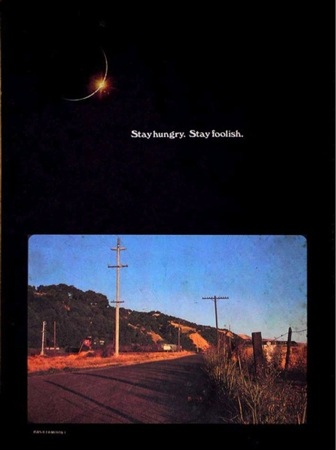
Stewart and his team put out several issues of The Whole Earth Catalog, and then when it had run its course, they put out a final issue. It was the mid-1970s, and I was your age. On the back cover of their final issue was a photograph of an early morning country road, the kind you might find yourself hitchhiking on if you were so adventurous. Beneath it were the words: "Stay Hungry. Stay Foolish." It was their farewell message as they signed off. Stay Hungry. Stay Foolish. And I have always wished that for myself. And now, as you graduate to begin anew, I wish that for you.

Stay Hungry. Stay Foolish.

Thank you all very much.

Tuesday, November 22, 2005

Modeling

[121 Thoughts]

I'm not talking about the fashion industry, but the building of a scientific (usually mathmatical) prototype to explain a given phanominum. It seems that my mind is built or trained to always try to find out the governing law behind a natural or socioeconomic hehavior. In gradschool I was in a lab that strives to discover the constitutional relation of materials. We put the material under all kinds of conditions and try to summarize its behavior in mathmatical equation(s). Likewise, using selected known behaviors (say in a stock market) I try to imagine a picture to explain those behaviors, and check if all known behaviors fit the picture. Ultimately this model will then predict unknown behaviors. Modeling is one of the most natrual habits of my mind. The hardest ones would be modeling of abstract things, such as musical cords, when I don't see a way to picture it. But of course it's also a bad example to use the stock market, which has been scrutinized ever since its inception and still no one has a good model, and probably never will. Modeling is fun, and I have to say there must be many many like minds out there.

Stock orders

1. Limit Order
Order to buy or sell a stated amount of stock at a specified price or better. [It guarantees the actual strike price to be better than specified (lower for selling and higher for buying).]

2. Stop Order
A stop order is an order to buy or sell a stock once the price of the stock reaches a specified price, known as the stop price. When the specified price is reached, your stop order becomes a market order, [which means the acutal price is not guaranteed to be better. The stop price is just a trigger point to activate the order.]

3. Stop Limit Order
An order to buy or sell at a specified price or better (called the stop-limit price) but only after a given stop price has been reached or passed. For example, an order to buy 100 MSFT 55 Stop 56 Limit, means that if the market price reaches 55 (stop price) or better (in the case of a buy, it would be less than 55) the order is then triggered to execute the order as a limit order at 56 or a better (lower) price. [the order is activated after the price hits 55, and will conduct the trade for anything better than 56, which could be 55.5 for buying, for example] Stop-limit orders avoid some of the risk a stop order has, but like all limit orders, carries the risk of missing the market all together, since the specified limit price or better may never occur.

Help me understand this...

As I often do when I think something is overvalued, but I don't really want to sell, I looked at the possibility of selling call options on my position. The December $300 call options were fetching $36 a share, meaning I could realize a further 15% gain if I sell the calls now and Google shares are above $300 in December. Then again, I could just sell some shares, even recouping all of my initial investment. One savvy friend of mine recommended selling a third of my position outright, selling covered calls on a third, and holding a third, which strikes me as a prudent course.

Wednesday, November 09, 2005

On Converting Old Analog Tapes to Digital

From Google Group:

Analog transfer via S-video vs. mini-jack from Hi8 source: How much quality loss?
All 8 messages in topic - view as tree

jfaugh...@spamcop.net
Mar 18, 11:32 am show options
Newsgroups: rec.video
Followup-To: rec.video
From: jfaugh...@spamcop.net - Find messages by this author
Date: 18 Mar 2005 11:32:17 -0800
Local: Fri, Mar 18 2005 11:32 am
Subject: Analog transfer via S-video vs. mini-jack from Hi8 source: How much quality loss?
Reply to Author | Forward | Print | Individual Message | Show original | Report Abuse

I've a question on video signal degradation when transferring analog
video output via a mini-jack A/V cable vs. an S-video cable.I'm rather
hoping Steve McDonald will see this and post a response, based on the
quote from a Jan 2005 message of his he knows this domain rather well!

Here's the specific question:

How much quality is lost when a @1998 SONY Hi8 analog camcorder
transfers Hi8 output with a high-quality (Monster $40) RGB RCA (3
component) to mini-video jack cable VERSUS a high quality S-video cable
with a separate audio-only RCA to mini-jack cable?

Here's the background if needed:

I have a @ 7 yo SONY analog Hi-8 camcorder with S-video I/O. I just
bought a Canon Elura 90. I have 30 days to return the Elura if I want
something else.

Here's the problem. The 2005 Elura 90s don't have S-video input/output.
They use an all-in-one mini-jack connector for analog I/O -- similar to
what digital cameras use.

One of the main things I want the Elura to do is reasonably high
quality conversion of my legacy Hi-8 tapes to digital format. I'll then
edit the digital tapes over time on my purchase-pending G5 iMac and
burn DVDs to archive.

--
john
john faughnan
jfaugh...@spamcop.net

meta: jfaughnan, jgfaughnan, digital video, Canon, SONY, passthrough,
pass-through, A/D conversion, video editing, Hi 8, Hi8

-------------------

Steve McDonald wrote:

(http://groups-beta.google.com/group/rec.video/msg/3d4be74dd7d39d44)

- Hide quoted text -
- Show quoted text -
> ... Although S-Video equipped VCRs have a lower band of recording
> frequency for the chroma sub-carrier and a higher band for the
luminance
> portion, the signal comes off the medium in composite form and then
is
> separated into two circuits to be output on an S-Video connector.
> Composite-only equipped VHS, 8mm and consumer Beta VCRs work the same
> way, but don't separate the two portions before they are output.
They
> also use the same "color-under" chroma sub-carrier and higher
luminance
> recording frequency system. You will note that a standard VHS
recording
> can be played on an S-VHS VCR and output as an S-Video signal, as
well
> as in composite form and an S-VHS recording playback can be output as
> either an S-Video or composite signal.

> S-VHS, Hi-8 and ED-Beta VCRs don't record a signal as "S-Video"
on
> tape. S-Video exists only as a transfer protocol on connecting
> circuits, except in a TV set with an S-Video input. There the signal
> remains as separate chroma and luma, for processing and onscreen
> display. If a TV receives a composite signal, it is separated into
> chroma and luma, as part of its pre-display process. The only
advantage
> of S-Video, is to keep the chroma and luma separate during the
transfer
> and this reduces the "crosstalk" or interference between the two
> frequency segments. This allows for more pure and richer color
> transfer, but it's only a relative benefit, not an absolute one.
> It appears that in most or perhaps all cases, component signal
> converters send a better video image than either S-Video or composite
> protocols will do..

> There are professional analog component recording formats, such
as
> BetaCam and M2, that have two separate recording tracks, one for
chroma
> and one for luma. With most digital video formats, it's all encoded
> into a single recording track.

> Equipment that has component outputs separates the output signal
> into three chroma circuits for RGB; the luma signal is derived and
> reconstituted from them in the unit to which they are sent.

> Steve McDonald


jfaughnan
Mar 18, 11:53 am show options
Newsgroups: rec.video
From: "jfaughnan" - Find messages by this author
Date: 18 Mar 2005 11:53:11 -0800
Local: Fri, Mar 18 2005 11:53 am
Subject: Re: Analog transfer via S-video vs. mini-jack from Hi8 source: How much quality loss?
Reply to Author | Forward | Print | Individual Message | Show original | Report Abuse

CORRECTION:

I wrote:

How much quality is lost when a @1998 SONY Hi8 analog camcorder
transfers Hi8 output with a high-quality (Monster $40) RGB RCA (3
component) to mini-video jack cable VERSUS a high quality S-video cable
with a separate audio-only RCA to mini-jack cable?

The RCA output is NOT RGB. It's video and two audio. May apologies.

So this should read:

How much quality is lost when a @1998 SONY Hi8 analog camcorder
transfers Hi8 output with a high-quality (Monster $40) RCA (1 video
composite, 2 audio) to mini-video jack cable VERSUS a high quality
S-video cable
with a separate audio-only RCA to mini-jack cable?


C.J.Patten
Mar 18, 12:19 pm show options
Newsgroups: rec.video
From: "C.J.Patten" - Find messages by this author
Date: Fri, 18 Mar 2005 15:19:32 -0500
Local: Fri, Mar 18 2005 12:19 pm
Subject: Re: Analog transfer via S-video vs. mini-jack from Hi8 source: How much quality loss?
Reply to Author | Forward | Print | Individual Message | Show original | Report Abuse

There are a lot of factors involved but, all things being equal, go with the
s-video connector.

The most graphic demonstration I've had of the difference was a Sony
Playstation hooked to a 32" Sony XBR TV, first with RCA jacks then with the
S-video.
Absolute night and day difference. The RCA seemed messy in comparison with
the s-video, almost smudged.

Try both hooked up to a TV and switch between them. I'd be surprised if you
ever used the RCA jack again when you can avoid it.

C.

"jfaughnan" wrote in message

news:1111175591.570754.200300@l41g2000cwc.googlegroups.com...

- Hide quoted text -
- Show quoted text -
> CORRECTION:

> I wrote:

> How much quality is lost when a @1998 SONY Hi8 analog camcorder
> transfers Hi8 output with a high-quality (Monster $40) RGB RCA (3
> component) to mini-video jack cable VERSUS a high quality S-video cable
> with a separate audio-only RCA to mini-jack cable?

> The RCA output is NOT RGB. It's video and two audio. May apologies.

> So this should read:

> How much quality is lost when a @1998 SONY Hi8 analog camcorder
> transfers Hi8 output with a high-quality (Monster $40) RCA (1 video
> composite, 2 audio) to mini-video jack cable VERSUS a high quality
> S-video cable
> with a separate audio-only RCA to mini-jack cable?


jfaughnan
Mar 18, 1:35 pm show options
Newsgroups: rec.video
From: "jfaughnan" - Find messages by this author
Date: 18 Mar 2005 13:35:57 -0800
Local: Fri, Mar 18 2005 1:35 pm
Subject: Re: Analog transfer via S-video vs. mini-jack from Hi8 source: How much quality loss?
Reply to Author | Forward | Print | Individual Message | Show original | Report Abuse

You've convinced me! I'll return the Elura 90 and get a camera with S
video input.

Another correspondent kindly sent a list of resolutions related to
video media. This isn't directly related to the issue of using the
S-video vs. mini-jack/composite video connectors, but it does show that
when one has recorded in Hi8 there's a lot to lose with an inferior
output solution. If VHS is comparable to 8mm, the jump from VHS to Hi8
is comparable in magnitude to the jump from Digital camcorder to HDTV.

The following list provides maximum playback resolution for different
camcorder video sources:

8MM - Up To 240 Lines of Resolution
8MM XR - Up To 280 Lines of Resolution

Hi-8 - Up To 400 Lines of Resolution
Hi-8 XR - Up To 440 Lines of Resolution
D8 (Digital 8) - Up To 500 Lines of Resolution
Mini DV - Up To 530 Lines of Resolution

High Definition - Up To 1080 Interlaced Lines of Resolution


Steve McDonald
Mar 19, 3:42 am show options
Newsgroups: rec.video
From: bigrocketm...@webtv.net (Steve McDonald) - Find messages by this author
Date: Sat, 19 Mar 2005 03:42:25 -0800
Local: Sat, Mar 19 2005 3:42 am
Subject: Re: Analog transfer via S-video vs. mini-jack from Hi8 source: How ...
Reply to Author | Forward | Print | Individual Message | Show original | Report Abuse

I sent a personal reply on this to jfaughnan. He can share it if
he likes. In brief, I vote for S-Video for this transfer purpose.

Steve McDonald


jfaughnan
Mar 19, 6:34 am show options
Newsgroups: rec.video
From: "jfaughnan" - Find messages by this author
Date: 19 Mar 2005 06:34:03 -0800
Local: Sat, Mar 19 2005 6:34 am
Subject: Re: Analog transfer via S-video vs. mini-jack from Hi8 source: How ...
Reply to Author | Forward | Print | Individual Message | Show original | Report Abuse

Steve's email message may have been zapped by my spamcop filters. I've
sent him a different email address to use and if he's able to resend
I'll post here.

I'm also summarizing this discussion on my blog, so it will have an
update too:

http://googlefaughnan.blogspot.com/2005/03/recvideo-google-groupsusen...


John Faughnan
Mar 19, 3:22 pm show options
Newsgroups: rec.video
From: "John Faughnan" - Find messages by this author
Date: 19 Mar 2005 15:22:17 -0800
Local: Sat, Mar 19 2005 3:22 pm
Subject: Re: Analog transfer via S-video vs. mini-jack from Hi8 source: How ...
Reply to Author | Forward | Print | Individual Message | Show original | Report Abuse

Below are excerpts from Steve's. Other than the value of S-video, he
urges the use of very short connectors. He has one composite plug cable
that's only 4 inches long!

.... If you want to do a lot of conversions with your new
camcorder, there would be a noticeable weakening of the colors with an
RCA composite connector....

...Myself, I wouldn't settle for anything other than S-Video for
transfering my Hi-8 recordings and I've been doing plenty of that. I'm
very pleased how well my old analog metal tapes have held up and how
good the images look when put on digital tape.

If you do use composite to transfer the Hi-8 footage, a
high-quality video cord, that is as short as possible, would be best.
I
wouldn't use an audio cord, even though it would match the connectors
and work, as they usually don't have wires that are as thick or
well-shielded as those intended for video...

... One of my Sony 4-pin composite video/audio plugs has just 4-inch
wires
that end in female inline jacks, for connecting with separate composite
and audio cords.


andreifilip...@gmail.com
Apr 4, 4:04 pm show options
Newsgroups: rec.video
From: andreifilip...@gmail.com - Find messages by this author
Date: 4 Apr 2005 17:04:21 -0700
Local: Mon, Apr 4 2005 4:04 pm
Subject: Re: Analog transfer via S-video vs. mini-jack from Hi8 source: How much quality loss?
Reply to Author | Forward | Print | Individual Message | Show original | Report Abuse

The easiest way to compare: send both signals to the monitor.
Technically S-Video connection was invented as something in between
composite (one cable) and component (3 cables) types of connection. You
actually have 2 cables in one S-Video cord. One is used for the
Luminance (brighter-darker) signal, second is for color information.
Presumably the signal loss is less with S-Video compare to RCA, since
you don't have to mix two signals on one end and separate them on the
other.

FAQ Video, http://faqvideo.com

Friday, October 28, 2005

Days of a week

[121 Words]

日* 日曜日 * Sunday * Dimanche * Sonntag
一* 月曜日 * Monday * Lundi * Montag
二* 火曜日 * Tuesday * Mardi * Dienstag
三* 水曜日 * Wednesday * Mercredi * Mittwoch
四* 木曜日 * Thursday * Jeudi * Donnerstag
五* 金曜日 * Friday * Vendredi * Freitag
六* 土曜日 * Saturday * Samedi * Samstag

Life insurance in plain language

  1. Term Life:
    - Fixed premium in fixed period of time (e.g. 10, 20 years--hence the name "term");
    - only pays if death happens within term, otherwise money is gone;
    - pure death benefit;
    - no cash value;

  2. Permament Life:
    1. Whole Life:
      - like Term Life except it's till death;
    2. Variable Life
      - fixed premium;
      - premium includes insurance cost (basically a whole life policy, this part is fixed) and the 'subaccounts' for investment (this is the variable part)
      - has garanteed minimum value, but can go above it;
      - make mutual-fund-like investments within the policy;
    3. Variable Universal Life
      - variable premium (makes it 'universal'), with the possibility of reducing or even eliminating it, but can go the other way also; the idea here is to have a high investment portion so the gain from the investment will cover the insurance cost, which can be quite high when you're older;
      - variable value;
      - more flexible;

Wednesday, October 12, 2005

All about termite and fumigation

Chemicals for fumigation:
1. Vikane Gas Fumigant (Sulfuryl Fluoride)
2. Methyl Bromide (stopped using in CA since September 2000)

detrimental vs. beneficial: 有害 vs. 有益

[121 Words]

Halcyon Life = 幸福美满的生活

[121 Words]

Tuesday, September 20, 2005

Eighty percent of life

Is just showing up (Woody Allen). If that's true, perhaps the other twenty percent is the efforts to finish well or making a decent exit.

Wednesday, September 14, 2005

EQ 的最高境界

应该可以归纳为「收放自如」四个字吧。

Friday, September 09, 2005

Bed sizes

  • Twin: 39 x 76 inches
  • Twin X-Long (this is for a slightly longer twin bed, which is commonly found in dorm rooms): 39 x 80 inches
  • Full: 54 x 75 inches
  • Queen (the most common bed size): 60 x 80 inches
  • King: 76 x 80 inches
  • California King (or "Cal King" - found mostly on the West Coast, longer and narrower than the regular King): 72 x 84 inches.

Wednesday, August 31, 2005

Hurricane Katrina

It devastated some of the Mexican Gulf costal areas. Among the most hit, New Orleans. Eighty percent of the city is under water (see pictures, streets that are dark are under water) mainly because the average elevation of the city is below sea level (some say the city is a bowl). I saw the video of a car sinking into the moving flow of flood water, and the camera crew ran to rescue the driver inside. Another story is a man who lost his wife (probably dead) to the flood water after holding on to her hand for as long as he could. And the last words he heard from her was 'You can't hold on to me...take care of the kids.' Two school-age boys were standing behind the man, looking lost. I suppose there would be thousands of heartbroken stories that have yet to be reported. The death roll of the catastorphy is feared to be into the thousands. Now the problem at the hands of the authorities is how to get the water out of the bowl.

Filial Piety (孝顺)

[121 Words]

Tuesday, August 02, 2005

黄淑帧

[121 People]

艺海拾贝 科海探珠 — 访第三届“上海市巾帼创新奖”获得者黄淑帧
□王 阳 摘自:上海妇女2004年3月刊

  黄淑帧,生于1938年,1957年就读上海第二医科大学医疗系。毕业后,在上海市第六人民医院、市卫生学校、市儿童医院医学遗传研究室工作。1985 年,赴美国科罗拉多医学中心及贝勒医学院任访问教授,后又在美国国立卫生研究院任高级研究员。现为上海市儿童医院医学遗传研究所研究员,上海交通大学医学院教授。
黄淑帧长期从事医学遗传学和胚胎工程学的研究,在遗传病的基因诊断、基因治疗、转基因动物和干细胞等领域成绩卓著,在国内外已发表论文 400多篇,30多次荣获国家级、省部级和上海市的重大科技成果奖,现已授权发明专利3项、实用新型专利1项,申请发明专利5项。作为首席科学家,黄淑帧连续5次获得美国国立卫生研究院科学基金。

曾经有一个艺术梦
学生时代,黄淑帧并没有学医的打算。那时,她热衷于文艺,忙着学琴,练声,演话剧。在上海市第三女子中学念书的时候,她担任学校话剧团团长。
市三女中,是黄淑帧心中最留恋的地方,她的组织能力都是高中三年锻炼出来的。那时候,为了排一台戏,从舞台灯光、道具、布景、服装到导演全都由她这个团长来统筹,舞台上的门窗请木匠师傅帮忙做,演出的服装请家长帮忙裁剪,最要紧的是,她还要给每个人安排角色。一台戏,只有一个主角,作为团长,她要协调,要做 “演员”的思想工作,更要以身作则。在《祥林嫂》里,黄淑帧就演别人不想演的角色“媒婆”,可当她扎着一块头巾,摇着一把扇子,活灵活现地走上场时,却一下子赢得了满堂彩。
除了演戏,黄淑帧还参加班里的女声小组唱。清晨7点,8个女中学生就开始在琴房里练声。她们的无伴奏合唱 《田野静悄悄》,让专家赞不绝口。而在练声的过程中,黄淑帧也渐渐懂得了怎样保持团队的和谐——不要突出个人,要用心倾听别人的声音。
花一样的年华总孕育着花一样的梦。临毕业时,颇有艺术天分的黄淑帧想报考音乐学院钢琴系。她7岁开始练琴,接受过很专业的训练。可后来,她又觉得弹钢琴不合适,“我不是个很安静的人,喜欢动脑子,让我整天面对一架钢琴恐怕不行。”
黄淑帧说自己小时候的性格象男孩,没有女孩的忸怩,不爱哭鼻子,整天都是风风火火,忙进忙出,即使是考大学那阵子,还惦记着排戏。而且好奇,什么都想学,每年的寒暑假一定要学一样东西,打字,拉手风琴,学唱越剧,指挥……
虽说黄淑帧的这些爱好最终都没有成为她的专业,可对艺术,她仍然兴致勃勃。毕业工作后,她曾在市工人文化宫独唱“蝴蝶夫人”,用美声来唱评弹“蝶恋花”,还得了优秀演出奖。
黄淑帧属于“玩兴很浓”的一种人,可她也绝对是一个很用功的学生。从小到大,黄淑帧一直是学校里的优等生。
黄淑帧说,弹钢琴,英语叫play piano,玩也是学习。玩得越多,知识面越广,读书就越轻松。
投身医学,成果斐然
选择医学,是因为黄淑帧看了一部苏联电影《没有说完的故事》,影片讲一名乡镇医生通过努力,让一位全身瘫痪的病人从病榻上站了起来。这部电影让黄淑帧对医生职业充满了敬意,她甚至觉得做医生治病救人,要比搞文艺有意义的多。于是,报考了上海第二医科大学医疗系。
黄淑帧上的是二医大医疗系本科,后来却被选入了在当时很超前的重点培养班生物物理专业。毕业后分配到上海市第六人民医院生化研究室工作。这是一个新筹建的实验室,她在室主任的带领下,凭着在学生时代培养锻炼出来的能力,从零开始,着手于实验室的建设和各种生化分析技术的建立,并很快适应了新的工作,作出了突出的成绩——和复旦大学遗传所合作发现了中国第一例异常血红蛋白HbM病。
可是正当黄淑帧踌躇满怀,准备在事业上大展宏图的时候,文革开始了。她被安排到第六人民医院626病房,当时病房推行“医、护、工一条龙”,晚上一个人值班,既要开医嘱,又要冲葡萄糖,凌晨三点,她要到楼下把水车推上来,冲满每个热水瓶,接着拖地板,搞卫生,然后为病人盛粥,换药,吊针,开刀……
在那个年代,黄淑帧没有对自己的工作感到失望,而是抓紧机会学习,培养了自己承受挫折的能力。
文革结束后,黄淑帧调到上海市儿童医院医学遗传研究室,继续她那中断了10多年的血红蛋白病研究,组织并参加了全国血红蛋白研究协作组,开展了大规模的血红蛋白病调查,发现了八种世界新型异常血红蛋白变种。随着改革开放,黄淑帧走出国门,两度赴美。黄淑帧说,她去美国,既不是赚钱,也不是镀金。当时儿童医院医学遗传研究室已发展为上海医学遗传研究所,她的丈夫,该所的所长曾溢滔希望妻子在美国能建立一个据点,和美国研究机构建立长期合作关系。
在国外七年,黄淑帧代表研究所和美国国立卫生研究院的科学家进行合作,在血红蛋白病研究方面取得显著的成果——获得了美国的专利,在国际顶级杂志发表研究论文,并以首席科学家的身份,申请到了美国国立卫生研究院5项科学基金。
1996 年,上海医学遗传研究所接受了一项极具挑战的国家863重大课题——转基因动物/乳腺生物反应器研究,曾溢滔所长给妻子打电话,要她回国。没有太多的考虑,黄淑帧就辞别了美国国立卫生研究院的合作伙伴,放下了正在进行的分子生物学研究,携带着转基因羊研究所必需的实验用品飞回了上海。
飞机抵沪,已是晚上9点,黄淑帧没有回家,直奔实验室。黄淑帧说自己是个喜欢做事情的人,有事情做,最开心了。
转基因羊的研究,对黄淑帧来说,是一个全新的领域。之前,她对羊的认识仅限于图片,电视,并没有接触过真正的羊,而现在,她却要让羊的乳腺按需分泌药物。为了尽快掌握羊的胚胎发育情况,黄淑帧来到了条件艰苦的农村,解剖了近百只山羊,进行了数千次的实验,通宵达旦地查阅国外文献资料,反复研究山羊生殖器的结构。经过无数个不眠之夜,她终于掌握了家畜胚胎发育的规律,设计和完善了转基因动物的研制路线,并制作了山羊非手术的胚胎移植器。这一科技创新使得转基因山羊的成功率提高了一倍多。1998年春,运用这些新技术获得的转基因羊咩咩坠地,黄淑帧如愿以偿地从它的乳汁中得到了用于治疗血友病的人凝血因子IX!这意味着人类通过动物乳汁来大量生产珍贵药物成为可能,该项研究被两院院士评为98中国十大科技进展之一。
在成功培育出转基因羊之后,黄淑帧又将视线移到了年产量远高于羊的牛身上。她带领课题组的同事们构建了人血清白蛋白的重组DNA载体,并于1998年5月进行了转基因试管牛的试验。1999年 2月,国际上第一例携带有人血清白蛋白基因的试管牛“滔滔”问世,这一成果再次被两院院士评为1999年中国十大科技进展之一,被科技部评为1999年中国十大基础科学新闻之首。
除了在转基因动物领域成绩卓著外,黄淑帧在地中海贫血的基因治疗和大量获取干细胞上也做出了巨大贡献。
“地中海贫血”是一种遗传性血液病,因无药可医,患者只有靠输血才能维持生命,但输血过多又会引起患者体内铁质含量沉积,导致心脏衰竭而亡。经过十多年系统和深入的研究,黄淑帧首次采用药物羟基脲来治疗地中海贫血,获得成功,成为国际上采用这一方法治疗地中海贫血的范例。同时,在对中国人特有的地中海贫血类型的发病机理进行深入研究的基础上,黄淑帧又构建了特异的反义RNA表达载体对该病进行实验性基因治疗研究,取得了满意的效果。该成果获得了2002年度上海市科技进步一等奖。
作为国家十五863项目的负责人,黄淑帧还首次建立了人/山羊异种移植嵌合体模型,在活体水平上证明了移植的山羊体内存在人源性细胞,为探索人类疾病的干细胞治疗提供了科学依据和一种可行的途径。在该领域,她申请了4项发明专利。
 
从医四十多年,黄淑帧因突出的科学成就而先后被评为上海市三八红旗手、上海市劳动模范、上海市先进女职工标兵和上海市优秀专业技术人才。
当获得这些荣誉时,黄淑帧非常认真地说,那都是领导的功劳,更是大家的功劳。“是领导发现了我,我只是一个工作人员,干事情的人,得不得奖都一样工作。”
黄淑帧的想法就是这样简单,对她来说,认准一件事去做,没有太多的患得患失,没有太多的包袱,工作充满着乐趣。
女儿,母亲骄傲的话题
采访之前,我们就听说黄淑帧还得过一个特别的奖——在第二届全国五好文明家庭表彰大会评出的十家“全国五好文明家庭标兵户”中,黄淑帧的家名列榜首。
黄淑帧的丈夫曾溢滔是中国工程院医药卫生工程学部的首批院士,国际著名的遗传学家,他完成了20多项具有国际水平的科研成果,曾被授予“国家级有突出贡献的中青年科技专家”称号,并获得全国五一劳动奖章。
如果说黄淑帧和曾溢滔这对科学家夫妻的结合是强强联手的话,那他们的女儿更是青出于蓝胜于蓝。
提起女儿,黄淑帧一脸的骄傲。
1992年,女儿曾凡一从美国6000名优秀大学毕业生的激烈角逐中脱颖而出,被美国宾夕法尼亚大学医学院录取为医学和生物学双博士生,成为当时被录取的第一位来自中国大陆的双博士留学生。
女儿承继了父母的衣钵。可让人称奇的是,端庄美丽的曾凡一极具音乐天赋。受酷爱艺术的母亲的影响,曾凡一四岁开始学琴,后又学声乐。她曾在上海首届外国流行歌曲大赛上,荣膺桂冠;在中央电视台举办的MTV大奖赛上,获得特别奖;在美国华盛顿,她成功举办了个人独唱音乐会……
问黄淑帧如何教女有方,黄淑帧笑了。她说她和丈夫平时工作忙,一直很注重培养女儿的独立能力。曾凡一上小学一二年级时,和外公外婆住在一起,夫妻俩每星期给女儿一定的生活费,让她安排每天的支出。在女儿的生活上,她这个做母亲的不用操很多心。该吃什么,该穿什么,该买什么,女儿从小就懂。
对女儿的学业,黄淑帧也不是“盯”得很紧,功课全凭自觉,只要做好了,就可以看电视。成绩考砸了,就分析原因,哪里跌倒,哪里再爬起来。不过,黄淑帧也有逼着孩子去学习的,那就是学钢琴,钢琴不练不行,这是为了磨练她的意志,干一件事就要把它干好,不能半途而废。
那一年,曾凡一准备出国。走之前,黄淑帧夫妇俩和她谈话,说,在上海你什么都有,前途一片光明。到美国,你所有的学费、生活费都得自己解决,一切从零开始。曾凡一没说什么,临走时,她给父母录了一首歌“大约在冬季”,她唱道“没有你的日子里,我会更加珍惜自己,没有我的岁月里,你要保重你自己”,请父母自己保重。还写了一张纸条,声明是自己要求去美国的,在美国一定努力学习,以优异的成绩来报答父母,请父母放心。
这首歌和这张纸条,让黄淑帧至今感动不已,女儿的独立,女儿的责任意识,让她颇感欣慰。
鉴于曾凡一在学业、人品、才艺上的优异表现,我国驻美使馆选派她为唯一参加世界女青年会百年庆典的中国代表。当曾凡一身着旗袍,手擎五星红旗款款步入会场时,不凡的气质赢得了在场所有人的喝彩。
而此时,在大洋的彼岸,黄淑帧、曾溢滔夫妇也为女儿的成长自豪并幸福着。